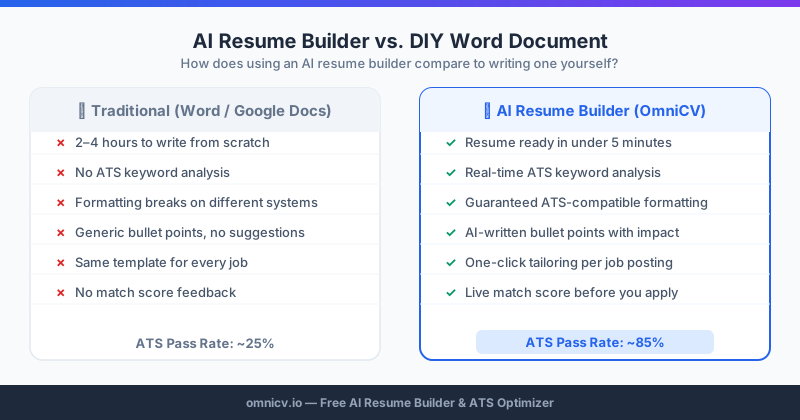
The resume writing industry has been transformed by artificial intelligence. In 2026, AI-powered resume builders go far beyond simple templates — they analyze job descriptions, generate tailored content, score ATS compatibility, and help job seekers create professional resumes in a fraction of the time it once took. Understanding how these tools work and which features actually matter can make the difference between a mediocre application and one that consistently lands interviews.
This guide covers everything you need to know about AI resume builders in 2026: how the technology works, which features to prioritize, common mistakes to avoid, and how to get the most value from these tools.
What Makes an AI Resume Builder Different from a Template Builder
Traditional resume builders are essentially design tools: you pick a template, fill in the blanks, and download a PDF. They provide structure and aesthetic polish but no intelligence about what content works, which keywords matter, or how your resume will perform against ATS screening.
AI resume builders operate at a fundamentally different level. They use several technologies working together:Natural Language Processing (NLP)
NLP allows the AI to analyze job descriptions and extract the terminology, required skills, and success criteria that employers are looking for. The same technology analyzes your existing experience and identifies how to frame your achievements in language that matches what hiring managers want to see.
Large Language Models (LLMs)
Modern AI resume builders use LLMs (the same family of technology behind ChatGPT and similar tools) to generate professional, contextually appropriate content from your raw experience data. You provide facts — "I managed a team and improved our deployment process" — and the AI produces polished, industry-appropriate language: "Led cross-functional engineering team of 8, implementing automated CI/CD pipeline that reduced deployment time by 65% and decreased production incidents by 40%."
ATS Simulation and Scoring
Sophisticated AI resume tools include ATS simulation — they parse your resume the same way an ATS would, identify which keywords are present and which are missing, and calculate a match score against a target job description. This feedback loop allows you to optimize before submitting rather than wondering why you are not hearing back.
Pattern Recognition and Benchmarking
AI models trained on millions of successful resumes can identify patterns: which achievement structures get higher callback rates, which skills combinations signal seniority, which formatting choices improve readability scores. This accumulated knowledge is applied to your resume in real time.
The Core Features That Matter in 2026
Not all AI resume builders are created equal. Here are the features that have the highest actual impact on job search outcomes:
1. Job Description Analysis and Keyword Matching
The single highest-value feature. A good AI resume builder should analyze any job description you paste in and immediately show you which keywords are present in your resume and which are missing. The best tools also suggest where and how to incorporate missing keywords naturally.
2. AI-Generated Achievement Bullets
Transforming vague responsibility descriptions into quantified, impactful achievement statements is where AI adds the most value. You input raw facts: the role, the scope, the outcome. The AI generates multiple professional phrasing options. You select, edit, and personalize.
3. Real-Time ATS Compatibility Score
Live scoring against a target job description as you edit. This immediate feedback loop allows iterative optimization — you can see exactly how each change affects your score.
4. Multiple ATS-Tested Templates
Template quality varies enormously. The best AI resume builders provide templates that have been tested against actual ATS platforms to ensure they parse correctly. Designs that look professional to human reviewers but fail ATS parsing are worthless.
5. One-Click Job Tailoring
Given that tailoring your resume for each application is the single most impactful optimization strategy, tools that automate this process provide enormous time value. A robust tailoring feature adjusts your summary, reorders and rewrites bullet points, and updates your skills section based on a target job description with minimal manual intervention.
6. Cover Letter Generation
Coordinated resume and cover letter content is significantly more compelling than the two written separately. AI tools that understand your resume content can generate cover letters that build on your resume's narrative rather than repeating it.
7. Content Improvement Suggestions
Beyond ATS scoring, good AI resume tools provide specific, actionable feedback: "This bullet point lacks a quantified result," "This section header is non-standard," "Add the certification mentioned in the job description."
OmniCV's AI Resume Builder: What Makes It Different
OmniCV was built with one objective: give every job seeker access to the kind of resume optimization previously only available to those who could afford professional resume writing services.
Key capabilities: Groq-Powered AI Writing: OmniCV uses Groq's ultra-fast inference to generate content suggestions and resume rewrites in real time — no waiting for results. Integrated ATS Checker: Every resume created in OmniCV can be instantly scored against a job description. The checker identifies missing keywords, flags formatting issues, and provides a match percentage. 15+ ATS-Tested Templates: Every template in OmniCV's library has been tested against Workday, Greenhouse, Lever, iCIMS, and Taleo to verify parsing accuracy. No template looks beautiful but fails ATS. Job Tailoring Feature: Paste any job description and OmniCV analyzes it, identifies keyword gaps in your current resume, and suggests targeted improvements to your summary and bullet points. GitHub Integration: For tech professionals, OmniCV can import your GitHub repositories, automatically extract tech stacks and project descriptions, and generate professional bullet points. This is a significant time-saver for engineers whose project experience is their strongest credential. Skill Gap Analysis: OmniCV's skill gap feature analyzes your current skills against a target role profile and identifies what to learn to become more competitive — turning your resume tool into a career development planning tool.How to Get Maximum Value from AI Resume Tools
Step 1: Start with Complete, Accurate Input Data
AI generates output only as good as your input. Before using any AI resume builder:
Step 2: Target One Role at a Time
AI resume tools deliver maximum value when you optimize for a specific role, not a generic version of your career. For each target role:
Step 3: Always Review and Personalize AI Content
AI generates professional, grammatically correct content — but it lacks your personal voice, specific context, and authentic accomplishments. Use AI output as a starting point, then:
Step 4: Test Before Submitting
Even with AI assistance, always perform the copy-paste test (paste your resume into Notepad to verify parsing) and check your ATS match score against the specific job description.
Step 5: Iterate Based on Results
Track your application-to-interview rate by job type, company size, and industry. If certain roles have low callback rates despite good ATS scores, the issue may be on the human review side — content quality, achievements, or positioning.
Comparing AI Resume Builder Options in 2026
The market offers several AI resume tools with varying capabilities and price points:
Free tier options — Most AI resume builders offer a free tier with limited templates and basic features. These are suitable for job seekers who need a professionally formatted resume and basic ATS checking. Premium features — Advanced ATS scoring, unlimited tailoring, AI cover letter generation, and career tools like skill gap analysis and interview prep are typically gated behind paid tiers. What to look for in any tool:Common Mistakes When Using AI Resume Builders
Accepting All AI Suggestions Without Review
AI resume tools improve your chances significantly, but they are not infallible. Always review suggested content for accuracy — particularly any specific achievements, metrics, or technical claims the AI generates. If the AI adds quantifications you cannot verify or did not achieve, remove or correct them.
Over-Optimizing for ATS at the Expense of Human Readability
A resume that scores 95% on ATS but reads like a keyword list will fail when it reaches the human reviewer. Aim for the intersection of keyword-rich and compelling narrative.
Using the Same Tailored Resume Multiple Times
AI tailoring is most effective when used for each specific application. Reusing a resume tailored for a specific role at another company with a different job description defeats the purpose.
Ignoring the Quality of the Template Foundation
Even the best AI content in a poorly structured template will fail ATS parsing. Verify that any template you use has been tested for ATS compatibility, not just optimized for visual appeal.
The Return on Investment of AI Resume Tools
Time savings: professional resume writers charge $200-$1,000 per resume and take 3-5 days. An AI resume builder produces similar or better results in 30-60 minutes.
Outcome improvements: candidates who use ATS optimization tools receive callback rates 2-3x higher than those who submit unoptimized resumes, according to multiple industry studies.
Accessibility: AI resume tools democratize access to professional-quality resume writing assistance. The same optimization previously available only to high-salary candidates who could afford professional writers is now accessible to every job seeker.
In 2026, not using an AI resume builder is equivalent to doing keyword research manually when SEO tools exist — possible, but inefficient and likely to produce inferior results. The right tool, used correctly, can compress your job search timeline from months to weeks.