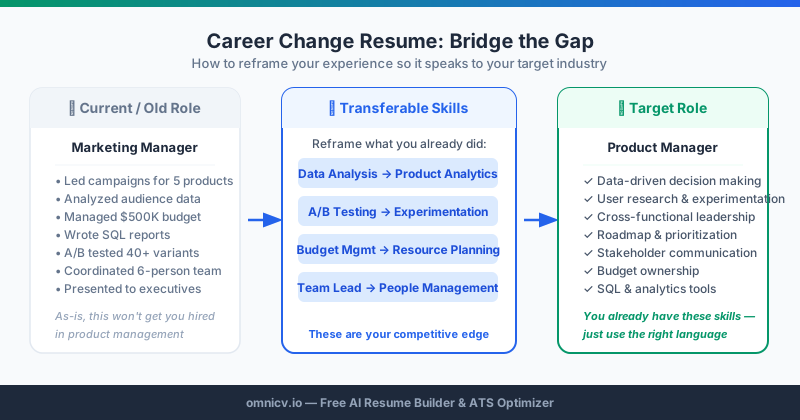
Career change resume strategy: transferable skills bridge from Marketing Manager to Product Manager showing data analysis, A/B testing, budget management as cross-industry skills
How to reframe your existing skills to make them relevant to your target role
Career Tips11 min read

How to Write a Resume for a Career Change in 2026

Transitioning to a new career? Learn how to write a resume that highlights transferable skills and positions you as a strong candidate.

OmniCV Team

Career & Resume Experts

Career transitions are one of the most challenging job search scenarios — and one of the most common. In 2026, with AI automating many traditional roles and new industries emerging rapidly, career changes have become a defining feature of modern professional life. LinkedIn's 2025 Workforce Report found that 35% of professionals considered a significant career change in the past year, up from 22% in 2023.

Your resume for a career change faces a specific challenge: it needs to make you credible in a field where you lack direct experience, while honestly representing your background. The right strategy turns your cross-industry experience from a liability into a compelling differentiator.

Why Standard Resume Advice Fails Career Changers

Most resume advice assumes you are moving within the same field — applying for a senior version of the role you currently hold, or moving laterally between similar companies. Career changers need a fundamentally different approach:

The problem with standard advice:
  • "Lead with your most recent role" — but your most recent role is in the field you are leaving
  • "Emphasize relevant experience" — but your direct experience is in a different industry
  • "Include industry keywords" — but your vocabulary is from your old field
  • The career changer's advantage:
  • Transferable skills are often more developed than those of single-track candidates
  • Cross-industry perspective is increasingly valued in management and strategy roles
  • Demonstrated ability to learn and adapt is itself a premium skill in 2026
  • Step 1: Identify and Articulate Your Transferable Skills

    Before writing a single word of your resume, map your existing skills to their equivalents in your target field. This translation exercise is the foundation of an effective career change resume.

    The Universal Transferable Skills Matrix

    These skills transfer across virtually every industry:

    Leadership and Management:
  • Team leadership → directly applicable anywhere
  • Project management → universally valued, consider PMP certification
  • Budget management → transferable with quantified proof
  • Analysis and Problem-Solving:
  • Data analysis → reframe around specific tools used (Excel, SQL, Python, Tableau)
  • Strategic planning → applicable to any strategy role
  • Research and synthesis → valuable in consulting, product, marketing
  • Communication and Influence:
  • Client/stakeholder communication → transferable to customer success, sales, consulting
  • Presentation and public speaking → valuable in sales, education, leadership
  • Writing and documentation → applicable to content, technical writing, marketing
  • Operations and Process:
  • Process improvement → universally valued (quantify with Lean/Six Sigma if applicable)
  • Workflow automation → add AI/automation tools to strengthen this
  • Cross-functional coordination → valuable in product management and operations
  • Domain-Specific Transfers

    From teaching to corporate training/L&D:

    Curriculum design → Instructional design; Classroom management → Facilitation skills; Student assessment → Performance measurement; Lesson planning → Training program development

    From military to civilian business:

    Mission planning → Strategic planning; Squad leadership → Team management; Operations management → Business operations; Intelligence analysis → Business intelligence/data analysis

    From healthcare to health tech/consulting:

    Clinical protocols → Process design; Patient management → Client management; Regulatory compliance → Compliance management; Healthcare IT → Health informatics

    From journalism to marketing/communications:

    Research and interviewing → Market research; Storytelling → Content marketing; Deadline management → Project management; Source development → Business development

    Step 2: Choose the Right Resume Format

    Career changers should use a hybrid (combination) format that gives you the best of both chronological and functional formats.

    The Hybrid Format Structure:

    1. Professional Summary (4-5 sentences)

    Your most important section. It must accomplish four things:

  • State your target role clearly
  • Highlight your most relevant transferable skills
  • Quantify your experience level
  • Acknowledge the transition while framing it as a strength
  • Strong career change summary example:

    "Marketing Director with 9 years of experience in consumer brand strategy, transitioning to Product Management. Deep expertise in customer segmentation, user research, A/B testing, and go-to-market execution directly applicable to product lifecycle management. Led cross-functional teams of 20+ across design, engineering, and sales to deliver campaigns reaching 5M+ consumers. Google Product Management Certificate (2025). Passionate about building data-driven products that solve real user problems."

    2. Transferable Skills Section

    Create a dedicated skills section organized around your target role's requirements — not your current role's vocabulary.

    Before (Marketing → Product transition): "Campaign Management, Brand Strategy, Social Media, Copywriting"

    After (repositioned for Product): "User Research, A/B Testing, Cross-functional Leadership, Data Analysis, Agile Methodology, Go-to-Market Strategy, Customer Segmentation, OKR Planning"

    3. Relevant Projects and Accomplishments

    Before your work history, add a "Selected Accomplishments" or "Relevant Projects" section that pulls out your most transferable achievements — even if they were in a different role or industry.

    4. Work Experience (Reframed)

    Your work history still appears but is now secondary to the above. Rewrite bullets to emphasize transferable elements:

    Before: "Managed email marketing campaigns for consumer goods brand"

    After: "Led end-to-end lifecycle of digital marketing products from ideation to delivery, coordinating 8-person cross-functional team, analyzing performance data across 3M users to optimize engagement by 35%"

    5. Education and Certifications

    List your new-field certifications prominently at the top of this section — before your traditional degrees.

    Step 3: Reframe Your Experience for the Target Field

    Reframing is different from misrepresenting. Every accomplishment you achieved in your previous career was real — you simply need to describe it using the vocabulary of your target field.

    Reframing Examples by Transition Type

    Teacher → Corporate Trainer/L&D:
  • "Developed curriculum for 150 students" → "Designed competency-based learning programs for cohorts of 150 learners, achieving 94% proficiency assessment pass rates"
  • "Managed classroom behavior" → "Facilitated professional development sessions for diverse adult learners, adapting delivery methods to maximize engagement and retention"
  • Accountant → Financial Technology (FinTech):
  • "Prepared financial statements" → "Automated financial reporting processes using Python and Excel, reducing monthly close cycle from 8 days to 3 days"
  • "Audited client accounts" → "Developed risk assessment frameworks analyzing financial data patterns across 200+ client portfolios"
  • Salesperson → Customer Success Manager:
  • "Closed $2M in new business annually" → "Managed full customer lifecycle from acquisition through expansion, driving $2M in ARR while maintaining 98% retention rate"
  • "Handled client objections" → "Developed strategic account management frameworks, identifying at-risk accounts through behavioral signals and implementing retention interventions"
  • The Vocabulary Bridge

    Every industry has its vocabulary. Career changers must demonstrate familiarity with their target field's language. Create a personal vocabulary mapping:

    | Your Current Vocabulary | Target Field Vocabulary |

    |------------------------|------------------------|

    | Students | Users / Customers / Clients |

    | Curriculum | Product / Program |

    | Grades/Assessment | Metrics / KPIs / Analytics |

    | Lesson plan | Roadmap / Sprint plan |

    | Parent communication | Stakeholder management |

    Step 4: Bridge the Credential Gap

    The most effective way to overcome the "no direct experience" objection is to acquire targeted credentials while you job search.

    High-Value Credentials for Common Transitions

    Into Product Management:
  • Google Product Management Certificate
  • AIPMM Certified Product Manager
  • Product School certification
  • Building a personal app or website as a portfolio project
  • Into Data Science/Analytics:
  • Google Data Analytics Certificate
  • IBM Data Analyst Professional Certificate
  • AWS Certified Cloud Practitioner
  • Kaggle competition portfolio
  • Into UX/Design:
  • Google UX Design Certificate
  • Nielsen Norman Group UX certification
  • Portfolio of 3-5 redesign case studies
  • Into Digital Marketing:
  • Google Digital Marketing & E-commerce Certificate
  • HubSpot Marketing Certification
  • Meta Blueprint Certification
  • Into Project Management:
  • PMP (Project Management Professional)
  • CAPM (Certified Associate in Project Management)
  • Scrum Master certification
  • List these credentials prominently in your education section and in your professional summary. Recruiters reviewing career changers specifically look for evidence of active investment in the new field.

    Step 5: Build a Supporting Narrative

    Your resume introduces your transition; your LinkedIn profile, cover letter, and networking conversations must reinforce the same narrative.

    The three-part career change narrative:
  • Why you are leaving: Frame positively (drawn toward, not fleeing from)
  • Why you are qualified: Specific transferable skills and new credentials
  • Why this specific role/company: Show you understand their world and have a clear value proposition
  • Strong transition statement: "After 8 years in healthcare administration, I developed deep expertise in process optimization and data analysis that I now want to apply to healthtech products. My experience managing clinical workflows for 500+ patients daily gives me user insight that typical product candidates lack — I know the actual pain points firsthand."

    Using AI Tools for Career Change Resumes

    OmniCV's AI resume builder is particularly valuable for career changers because it can:

    Analyze target job descriptions and identify which of your existing skills map to required qualifications — giving you a prioritized list of what to emphasize and what to reframe. Suggest vocabulary bridges — help you translate your current-field experience into target-field language without requiring you to know the exact terminology in advance. Generate reframed bullet points — given your raw achievement data, OmniCV's AI can produce multiple versions using different industry vocabularies so you can choose the framing that best fits the target role. Identify credential gaps — compare your profile to the target role's requirements and surface the 2-3 most high-value credentials to acquire.

    Career changes are challenging because they require you to simultaneously demonstrate what you know and acknowledge what you are still learning. The candidates who succeed are those who invest in the narrative work — building a coherent story that connects their experience to their target, using the target field's vocabulary, and demonstrating genuine commitment through credentials and projects. With the right strategy and tools, a career change becomes not a liability but the source of a genuinely differentiated candidacy.

    Frequently Asked Questions

    Is it harder to get interviews when changing careers?

    Yes, initially — but the difficulty decreases significantly with the right positioning strategy. Career changers who clearly articulate transferable skills, demonstrate target-field credentials, and reframe their experience using target-field vocabulary see callback rates comparable to direct experience candidates. The key difference is that a career changer must do more proactive positioning work on the resume, while a same-field candidate relies more on direct experience matching.

    Should I explain my career change in my resume?

    Yes, briefly — in your professional summary. Your summary should name your target role and highlight your most relevant transferable skills, giving the reviewer an immediate framework for interpreting your non-traditional background. A cover letter should provide more context, but your resume summary should at minimum prevent the reviewer from being confused about why you are applying.

    How long does a career change job search typically take?

    Career transitions typically take 3-6 months longer than same-field searches. This is due to the additional positioning work required, the need to build new networks, and the natural filtering effect of ATS systems that weight direct experience. Strategies that compress timeline: target companies known for valuing diverse experience, network into the field before formally applying, and use transferable skills to target adjacent roles rather than starting at entry level.

    Do I need to take a pay cut when changing careers?

    Not necessarily, though it is common at first. The pay trajectory depends on the seniority level you enter at. Many career changers accept a lateral or slightly lower title in the new field but maintain comparable compensation, particularly when they bring years of transferable experience in high-value areas like leadership, data analysis, or client management. Be realistic about entry-level adjustments but set clear expectations for growth based on what you bring.

    What if I have no direct experience in the new field at all?

    Start by acquiring targeted credentials (certifications, online courses, portfolio projects) that demonstrate genuine commitment and foundational knowledge. Build a portfolio project — a personal app, a data analysis project, a redesigned website — that demonstrates applied skills. Network actively in the target field through professional events, LinkedIn, and informational interviews. Aim for adjacent roles first: a teacher moving into tech might first target educational technology companies where their content expertise is valued alongside their new technical skills.

    Try OmniCV Free

    Ready to build your perfect resume?

    Create an ATS-optimized resume in minutes with AI-powered writing and 45+ professional templates.

    Create Your Resume →