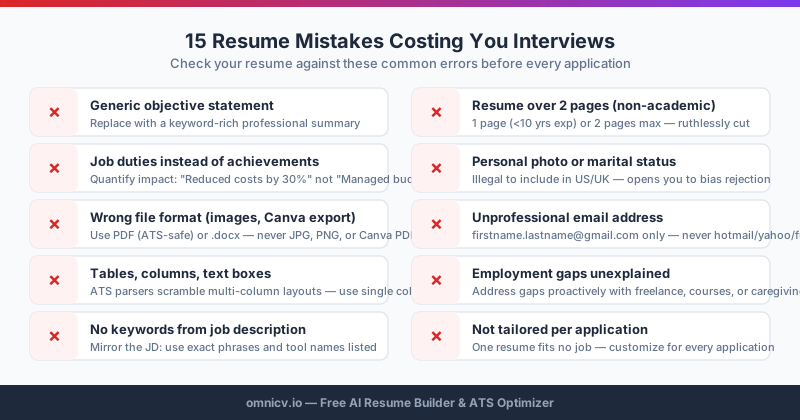
Even highly qualified candidates lose opportunities because of easily fixable resume mistakes. According to a 2025 survey by Jobscan, 43% of resumes fail ATS screening due to formatting errors alone — errors that have nothing to do with the candidate's actual qualifications. And recruiters who do manually review resumes spend an average of 7 seconds on initial review; presentation mistakes end that review early.
Here are the 15 most costly resume mistakes in 2026 — and exactly how to fix each one.
Formatting Mistakes
Mistake 1: Using a Multi-Column Layout
Why it costs you interviews: Multi-column resumes are visually appealing but catastrophic for ATS parsing. Most ATS systems read left to right across the full page width — so your right-column content merges mid-sentence into your left-column text, creating unreadable garbled output. The ATS may score you near zero because it cannot correctly classify your experience, education, or skills. The fix: Convert to a single-column format. Use font sizes, bold text, and spacing to create visual hierarchy instead of columns. A single-column resume can look just as polished while ensuring every word is accurately parsed.Mistake 2: Placing Contact Information in Headers or Footers
Why it costs you interviews: Document headers and footers are frequently skipped by ATS parsers. If your email address is in the document header, it may never be captured. The recruiter receiving a 90% match resume with no contact information cannot reach you. The fix: Place all contact information — name, email, phone, LinkedIn, city/state — in the main body of your document, at the very top of page one.Mistake 3: Using Text Boxes, Tables, or Graphics
Why it costs you interviews: Content inside text boxes and tables is invisible to most ATS parsers. Any skills listed in a sidebar text box, any experience in a table, any certification in a graphic element — gone. You may think your resume is comprehensive while the ATS sees half the document. The fix: Remove all text boxes, layout tables, and graphics. Format everything as regular body text with standard paragraph and bullet formatting.Mistake 4: Using Fancy or Non-Standard Fonts
Why it costs you interviews: Decorative fonts may not render correctly during ATS parsing, causing text to appear as symbols or be skipped. They also affect human readability — recruiters subconsciously associate unusual fonts with lack of professionalism. The fix: Use standard, widely supported fonts: Arial, Calibri, Georgia, Garamond, Helvetica, or Times New Roman. Body text at 10-12pt, headers at 14-16pt.Mistake 5: Incorrect or Inconsistent Resume Length
Why it costs you interviews: A 4-page resume for a 3-year career signals poor judgment and self-editing skills. A half-page resume for a 15-year career leaves the reviewer hungry for evidence of your experience. Both extremes reduce your callback rate. The fix:Content Mistakes
Mistake 6: Vague, Responsibility-Focused Bullet Points
Why it costs you interviews: "Responsible for sales" describes a job requirement, not your accomplishment. It gives the ATS nothing specific to score and gives the human reviewer no evidence of impact. It is the most common resume mistake and the one with the highest cost. The fix: Use the formula: Action Verb + Specific Activity + Measurable Result| Weak | Strong |
|------|--------|
| "Managed social media accounts" | "Grew LinkedIn following by 142% in 12 months through data-driven content strategy, contributing to 28% increase in qualified inbound leads" |
| "Responsible for customer service" | "Resolved 500+ customer tickets monthly with 97% satisfaction rating, maintaining zero escalations to management for 18 consecutive months" |
| "Helped improve processes" | "Redesigned onboarding workflow reducing new-hire time-to-productivity from 6 weeks to 3 weeks, saving 120 hours of training per cohort" |
Mistake 7: Using a Generic, Untailored Resume
Why it costs you interviews: A generic resume typically scores below 50% on ATS keyword matching for any specific role. Different positions emphasize different skills, use different terminology, and require different achievement framing. The fix: Treat your resume as a living document. For every application, spend 15-20 minutes:Research from Resume Lab shows tailored resumes receive 3x more callbacks than generic ones. This is the single highest-ROI investment in your job search.
Mistake 8: No Quantification of Achievements
Why it costs you interviews: Numbers are the universal language of impact. "Increased sales" means nothing. "Increased Q3 sales by 35%, generating $1.8M in new ARR" is memorable, credible, and ATS-optimized. The fix: Audit every bullet point. For each one, ask: "Can I add a number here?" Quantify:If you do not have exact numbers, use ranges: "reduced costs by approximately 30%" or "served 200+ enterprise clients."
Mistake 9: Including an Outdated Objective Statement
Why it costs you interviews: "Seeking a challenging position to leverage my skills in a dynamic organization" tells the recruiter nothing about you and takes up valuable space. The word "objective" is search-engine-dead — it is a keyword the ATS correctly identifies as low-information content. The fix: Replace with a Professional Summary — 3-4 sentences that include your target job title, years of experience, 4-6 keywords, and one quantified differentiator. This positions you immediately and gives the ATS exactly what it needs.Mistake 10: Typos and Grammatical Errors
Why it costs you interviews: A 2025 CareerBuilder survey found 77% of hiring managers say a single typo makes them less likely to interview a candidate. In roles requiring attention to detail, communication skills, or client-facing work, a typo signals unreliability before the interview begins. The fix:Mistake 11: Including Irrelevant Personal Information
Why it costs you interviews: Age, marital status, religion, photo, height, weight, and hobbies unrelated to the role add length without value and can trigger unconscious bias or legal concerns that cause recruiters to pass without having a valid reason. The fix: Include only: name, professional email, phone, location (city/state), LinkedIn URL, portfolio/GitHub link (if relevant). Remove everything else personal.Strategic Mistakes
Mistake 12: Not Including a LinkedIn URL
Why it costs you interviews: 87% of recruiters use LinkedIn to research candidates before or after reviewing a resume. A missing LinkedIn URL forces the recruiter to search for you manually — creating friction they may not overcome. Even worse: they might find the wrong person. The fix: Add your LinkedIn URL to your contact section. Ensure your LinkedIn profile is complete, consistent with your resume, and has a professional headshot. Customize your LinkedIn URL to remove the default string of numbers.Mistake 13: Using an Unprofessional Email Address
Why it costs you interviews: "hotguy99@yahoo.com" or "partytime@aol.com" immediately undermine your professional credibility before the recruiter reads a single achievement. The fix: Create a professional email address: firstname.lastname@gmail.com or firstname@professionaldomain.com. If your name is common, add a middle initial or professional qualifier.Mistake 14: Listing "References Available Upon Request"
Why it costs you interviews: This phrase is universally understood to mean "I have references, same as every other candidate." It occupies a full line without adding any information. In 2026, every resume implies references are available. The fix: Remove this line entirely. Use the space for an additional achievement or skill.Mistake 15: Submitting Without ATS Testing
Why it costs you interviews: You may have formatted everything correctly by eye, but you cannot know how your resume will parse without testing it against an ATS simulation. The fix: Before every application:Quick-Fix Checklist
Run through this before every submission:
Format✅ Single-column layout
✅ .docx or clean PDF format
✅ Contact info in main document body
✅ Standard fonts (Arial, Calibri, Georgia)
✅ Appropriate length (1-2 pages for most roles)
Content✅ Professional summary with target job title + keywords
✅ Achievement bullets quantified with numbers
✅ Tailored to this specific job description
✅ No typos or grammar errors
✅ No irrelevant personal information
Strategy✅ LinkedIn URL included
✅ Professional email address
✅ ATS match score verified (75%+)
✅ Copy-paste test performed
✅ No "References Available Upon Request"
Fixing even five of these fifteen mistakes can double your interview callback rate. The good news: every single one is correctable in under an hour with the right tools and attention.