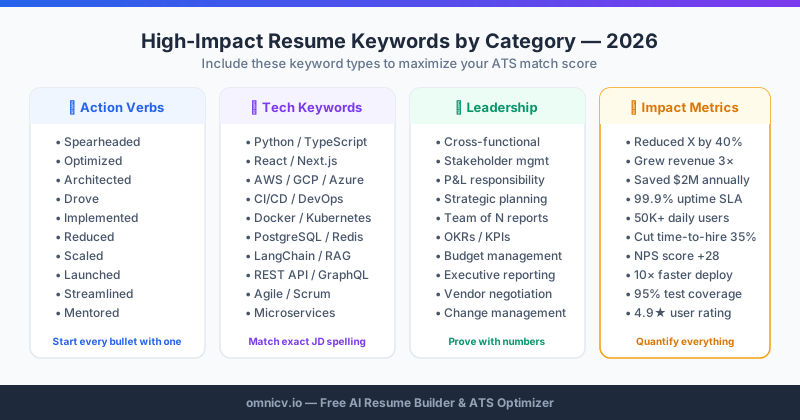
Resume keywords are the bridge between your experience and the job you want. In 2026, with AI-enhanced ATS systems scanning every application, keyword strategy has become as important as the actual content of your resume. The right keywords ensure your qualifications are recognized. The wrong ones — or the right ones placed incorrectly — mean your resume never reaches a human reviewer.
This guide covers the science of resume keywords: which types matter most, how to identify them for any role, how to place them for maximum ATS impact, and which keywords are currently in highest demand across major industries.
Why Keywords Are the Foundation of ATS Success
ATS systems score your resume by comparing it against the job description. The scoring algorithm looks for:
A 2025 analysis of 1 million job applications found that resumes matching 75% or more of a job description's key terms received callbacks at 3x the rate of resumes matching below 50%. Keyword optimization is not optional — it is the entry price for every competitive job application.
The Four Categories of Resume Keywords
1. Hard Skills Keywords
Specific, teachable abilities tied to technical tools, software, platforms, or methodologies.
Technology:2. Soft Skills Keywords
Behavioral and interpersonal competencies. In 2026, ATS systems have become better at detecting soft skill keywords that appear in context. Importantly, every soft skill claim must be supported by evidence in your experience bullets.
High-value soft skills to include (with evidence):3. Action Verbs
The opening words of your achievement bullets. Strong action verbs signal initiative and impact to both ATS and human readers.
Leadership and management:Led, Directed, Managed, Oversaw, Mentored, Developed, Built, Scaled, Grew, Championed
Achievement and impact:Increased, Improved, Reduced, Accelerated, Optimized, Streamlined, Transformed, Delivered, Generated, Saved
Technical and development:Architected, Engineered, Implemented, Designed, Developed, Built, Deployed, Automated, Integrated, Migrated
Analysis and strategy:Analyzed, Evaluated, Assessed, Modeled, Forecasted, Researched, Identified, Synthesized, Recommended, Advised
4. Industry Jargon and Domain Terms
Role-specific language that demonstrates you belong in the industry. These terms are powerful ATS signals because they appear in job descriptions and indicate domain familiarity.
SaaS/Technology:ARR, MRR, churn rate, NPS, product-led growth (PLG), go-to-market (GTM), total addressable market (TAM), developer experience (DevEx)
E-commerce:Average Order Value (AOV), Gross Merchandise Volume (GMV), fulfillment rate, cart abandonment, customer lifetime value
Healthcare:Care pathways, value-based care, population health management, clinical workflows, patient outcomes, readmission rates
Finance:Alpha generation, beta management, risk-adjusted returns, NAV, AUM, regulatory capital, stress testing
How to Find Keywords for Any Job Posting: A Step-by-Step Process
Step 1: Deep-Read the Job Description
Read the posting three times:
Step 2: Extract Three Categories
From your reading, extract:
Step 3: Research the Competitive Landscape
Search for 3-5 similar job postings at different companies. Terms that appear in all or most postings are universal keywords — your highest-priority targets. Terms unique to one posting are secondary.
Step 4: Cross-Reference Against Your Resume
Create a simple table:
| Keyword | In My Resume? | Where? | Priority |
|---------|---------------|--------|----------|
List every keyword from steps 2-3, then check your current resume for each. Gaps in the "In My Resume?" column become your optimization targets.
Step 5: Use an ATS Checker
Tools like OmniCV's ATS checker automate steps 3-4: paste your resume and the job description, and receive an instant keyword gap analysis with a match percentage. Use the gap list as your editing checklist.
Keyword Placement: Where to Put Keywords for Maximum ATS Impact
The same keyword has different weight depending on where it appears in your resume:
Highest Impact: Professional Summary
The first section the ATS reads, often given extra weight in scoring algorithms. Your summary should contain 4-6 high-priority keywords from the job description — naturally integrated, not listed.
Example:"Product Manager with 7 years of experience in B2B SaaS, specializing in agile product development, customer discovery, and go-to-market strategy. Proven track record of shipping 0-to-1 products that achieved $5M ARR within 18 months."
Keywords present: Product Manager, B2B SaaS, agile product development, customer discovery, go-to-market, ARR — all high-value terms that appear naturally.
High Impact: Skills Section
A dedicated keyword zone. Categorize your skills and update this section for every application.
High Impact: Job Titles
Use standard industry job titles, not internal company titles (unless they are the same). "Customer Success Manager" outscores "Client Happiness Champion" even if both describe the same role.
Good Impact: Achievement Bullets
Keywords within the context of achievement descriptions carry strong weight. This is where hard skills and action verbs combine for maximum ATS scoring.
Lower Impact: Education and Certifications
Important to include, but these sections are less heavily weighted for keyword scoring (though certifications themselves are often mandatory filters — you pass or fail based on their presence, not their keyword weight).
The Most In-Demand Keywords Across All Industries in 2026
Based on analysis of 2025-2026 LinkedIn Workforce Report and job posting data:
Universal keywords appearing across industries:Common Keyword Mistakes That Kill Your ATS Score
Mistake 1: Using synonyms instead of exact termsIf the job says "content marketing," do not write "content creation" or "content development." Use the exact phrase.
Mistake 2: Acronyms without full forms"SEO" might not match "Search Engine Optimization" in some systems. Write both: "Search Engine Optimization (SEO)."
Mistake 3: Keyword stuffingIncluding irrelevant keywords or repeating the same term 10 times to game the system. Modern ATS platforms flag unnatural keyword density, and human reviewers will reject a keyword-stuffed resume immediately.
Mistake 4: Hiding keywords in white textSome job seekers have tried placing white text on a white background to include extra keywords. ATS platforms now detect and penalize this practice — it is grounds for immediate rejection at many companies.
Mistake 5: Not tailoring per applicationA resume with excellent keywords for a marketing role will score poorly for a finance role even if you are qualified for both. Each application requires keyword tailoring.
Keyword Strategy for Career Changers
Career changers face a unique keyword challenge: your experience uses different terminology than your target industry. The solution:
Step 1: Build a keyword bridgeMap your existing experience vocabulary to target-industry equivalents:
Project management, data analysis, leadership, communication, and problem-solving are valued across industries. Lead with these transferable keywords.
Step 3: Add domain credentialsCertifications, online courses, and projects that use target-industry terminology add legitimate keywords and demonstrate commitment to the transition.
With OmniCV's AI resume builder and ATS checker, you can see exactly which keywords your current resume is missing for a target role — giving you a precise, prioritized list of what to add, reframe, or acquire before applying.