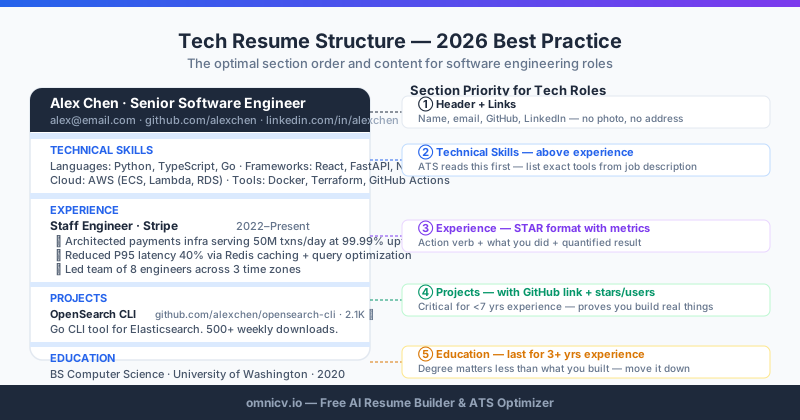
The tech job market in 2026 is simultaneously more competitive and more dynamic than at any point in the past decade. AI tools are reshaping what senior engineers do, new specializations are emerging monthly, and the skills that commanded premium salaries two years ago are being commoditized. For tech professionals — software engineers, data scientists, DevOps engineers, product managers, and their peers — a resume is not just a career document. It is the first demonstration of your technical judgment and communication skills.
This guide covers everything tech professionals need to know about resume writing in 2026: which sections matter most, how to present technical skills, how to showcase projects effectively, and how to demonstrate AI literacy — the newest differentiating skill set in every technical role.
The Unique Challenges of a Technical Resume
Tech resumes face challenges that no other resume type shares:
The ATS keyword problem is amplified: Technology vocabulary changes rapidly. ATS systems checking for "React" may not recognize "React.js" as a match. The gap between your resume vocabulary and the job description language can be significant even if you are technically qualified. Skills lists become stale quickly: Technologies become obsolete. Listing proficiency in jQuery in 2026 raises more questions than it answers. Your skills section needs active curation. Projects are often your strongest credential: For many tech roles, what you built is more impressive than where you worked. But most engineers dramatically undersell their projects on their resumes. Seniority signals must be explicit: The difference between a mid-level and senior engineer resume is not just years of experience — it is the scope, scale, and architectural complexity of the problems described.The Tech Resume Structure That Works in 2026
1. Professional Summary (3-4 sentences)
Open with a crisp, keyword-dense summary that positions you for the specific role. For tech roles, this means:
2. Technical Skills Section
The most important section for ATS keyword matching in tech roles. Structure it by category, be specific, and update it for every application.
Recommended categories: Languages:Python 3.x, TypeScript, JavaScript, Go, Rust, Java 17, SQL, Bash
Frontend:React 18, Next.js 14, Vue 3, Tailwind CSS, HTML5, CSS3, Webpack, Vite
Backend:Node.js, Express, FastAPI, Django, Spring Boot, GraphQL, REST APIs, gRPC
Cloud & Infrastructure:Amazon Web Services (AWS) — EC2, ECS, Lambda, RDS, S3, CloudFront
Google Cloud Platform (GCP) — GKE, Cloud Run, BigQuery
Microsoft Azure — AKS, Azure Functions, Cosmos DB
Terraform, Pulumi, CDK
DevOps & CI/CD:Docker, Kubernetes, GitHub Actions, CircleCI, Jenkins, ArgoCD
Prometheus, Grafana, Datadog, PagerDuty
Databases:PostgreSQL, MySQL, MongoDB, Redis, Elasticsearch, DynamoDB, Snowflake
AI/ML (2026 addition):OpenAI API, LangChain, LlamaIndex, RAG pipelines, prompt engineering
PyTorch, TensorFlow, Scikit-learn, Pandas, NumPy
Tools:JIRA, GitHub, GitLab, Linear, Figma, Postman, VS Code, IntelliJ
Key principles for your skills section:3. Work Experience with Engineering-Specific Impact Metrics
Tech work experience bullets have a specific challenge: making technical accomplishments legible to both ATS systems and non-technical hiring managers or recruiters.
The formula for a high-impact tech bullet:[Action Verb] + [Technical Context] + [Scale/Scope] + [Measurable Outcome]
Examples by role: Software Engineer:4. Projects Section (Critical for Many Tech Roles)
For engineers with fewer than 7 years of experience, significant personal or open-source projects can be as compelling as — or more compelling than — work experience. Even senior engineers benefit from a curated projects section.
What makes a project entry compelling: 1. Clear problem statement: What problem does this solve? Why did you build it? 2. Technology stack: Explicit mention of every tool used (ATS keyword optimization) 3. Scale and impact: Users, requests, data volume, stars, contributions 4. GitHub link: Essential for verification and deeper review Strong project entry format:OmniFlow — AI-Powered Workflow Automation Platform
github.com/username/omniflow | 1.2K GitHub stars | 500+ active users
Built and deployed serverless automation platform using Next.js 14, Python FastAPI, PostgreSQL, and AWS Lambda. Integrated GPT-4 API for natural language workflow creation, reducing automation setup time from hours to minutes. Scaled to handle 50K+ workflow executions monthly at <$100/month infrastructure cost.
Personal Portfolio Website
Made a website to show my work. Used React and CSS.
5. GitHub Profile Optimization
In 2026, a well-maintained GitHub profile is nearly as important as your resume for many technical roles. Tech-savvy recruiters and all engineering managers will review it. Ensure:
✅ GitHub URL is in your resume contact section
✅ Profile README introduces your skills and interests
✅ Pinned repositories showcase your 4-6 best projects
✅ README.md files exist for every significant repository
✅ Commit history shows consistent activity
✅ Open source contributions appear in activity feed
OmniCV's GitHub integration can automatically import your top repositories, extract tech stacks and project descriptions, and generate professional resume bullet points — turning your commit history into compelling resume content.
Demonstrating AI Literacy: The 2026 Differentiator
Every tech role in 2026 now values AI literacy. A 2025 LinkedIn survey found that 56% of job postings for senior technical roles now mention AI tools, LLMs, or machine learning — even for roles not traditionally considered AI-focused.
How to demonstrate AI literacy on your resume:
For software engineers:"Integrated OpenAI GPT-4 API to build intelligent code review assistant, reducing PR review time by 40% and catching 3x more logic errors than manual review"
"Implemented RAG pipeline using LangChain and Pinecone enabling semantic search across 500K+ internal documents, reducing average research time from 45 minutes to 4 minutes"
"Used GitHub Copilot to accelerate feature development velocity by approximately 35% (measured by story points per sprint) while maintaining 95%+ test coverage"
For data professionals:"Built LLM-powered data quality monitoring system using OpenAI and dbt, automatically detecting schema drift, semantic anomalies, and data lineage breaks across 300+ models"
For DevOps/Platform:"Developed AI-assisted incident response system using GPT-4 API to parse alerts, suggest probable root causes, and draft incident reports, reducing L1 triage time by 60%"
Even if you have not built production AI systems, demonstrate AI productivity tool usage: Cursor, GitHub Copilot, ChatGPT/Claude for debugging, Codeium. These signals matter.
Tech-Specific ATS Optimization
Keyword Precision Matters More in Tech
Tech ATS systems are particularly keyword-sensitive because technology names are unique identifiers, not semantic categories. "PostgreSQL" and "MySQL" are different keywords — you cannot rely on semantic matching.
Rules for tech keyword precision:The Seniority Signal Problem
ATS systems for senior roles often filter on seniority signals — and human reviewers form immediate impressions of level. Ensure your resume signals the right seniority:
Mid-level signals: "Implemented features," "Worked on team," "Developed components," "Fixed bugs" Senior signals: "Designed architecture," "Led team of N," "Defined technical strategy," "Owned system reliability," "Mentored engineers" Staff/Principal signals: "Drove org-wide technical initiative," "Influenced engineering culture," "Set technical direction across teams," "Partnered with VP Engineering"Common Tech Resume Mistakes
❌ Listing every technology ever touched — implies shallowness; curate to what you can confidently discuss
❌ No quantification of engineering impact — "built microservices" is weak; "built microservices processing 50M daily requests with 99.98% uptime" is strong
❌ No GitHub link — in 2026, this is like a writer not having writing samples
❌ Outdated technologies as primary skills — jQuery, AngularJS, Python 2, Flash — remove or de-emphasize
❌ No projects section for engineers under 7 years experience — projects often outweigh internship bullet points
❌ Missing AI/ML section — even basic AI tool usage is now a relevant signal
The ATS Check for Tech Resumes
Tech roles are often high-volume hiring situations where ATS screening is rigorous. Before every application:
The combination of precise keyword strategy, quantified impact, meaningful projects, and demonstrated AI literacy positions you in the top 10% of tech resumes — regardless of whether you attended a top university or worked at a famous company. In 2026, what you built and how you describe it matters more than the prestige of the org chart above you.